
FoXX Health: Designing a unified health signal system
Connecting symptoms, wearable data, and contextual events into a unified health tracking experience.
—
Overview
FoXX Health is a women’s health companion app designed to help users track symptoms, wearable data, and health events, and understand how these signals connect over time.
The product brings together multiple types of health inputs into a single experience, allowing users to log daily changes and view patterns across time through structured insights.
This project focuses on designing the core health tracking and signal interpretation system across the product.
Contribution
I designed the end-to-end health tracking system for FoXX Health, defining how symptoms, wearable data, contextual events, and user profile attributes are structured and connected within a unified model.
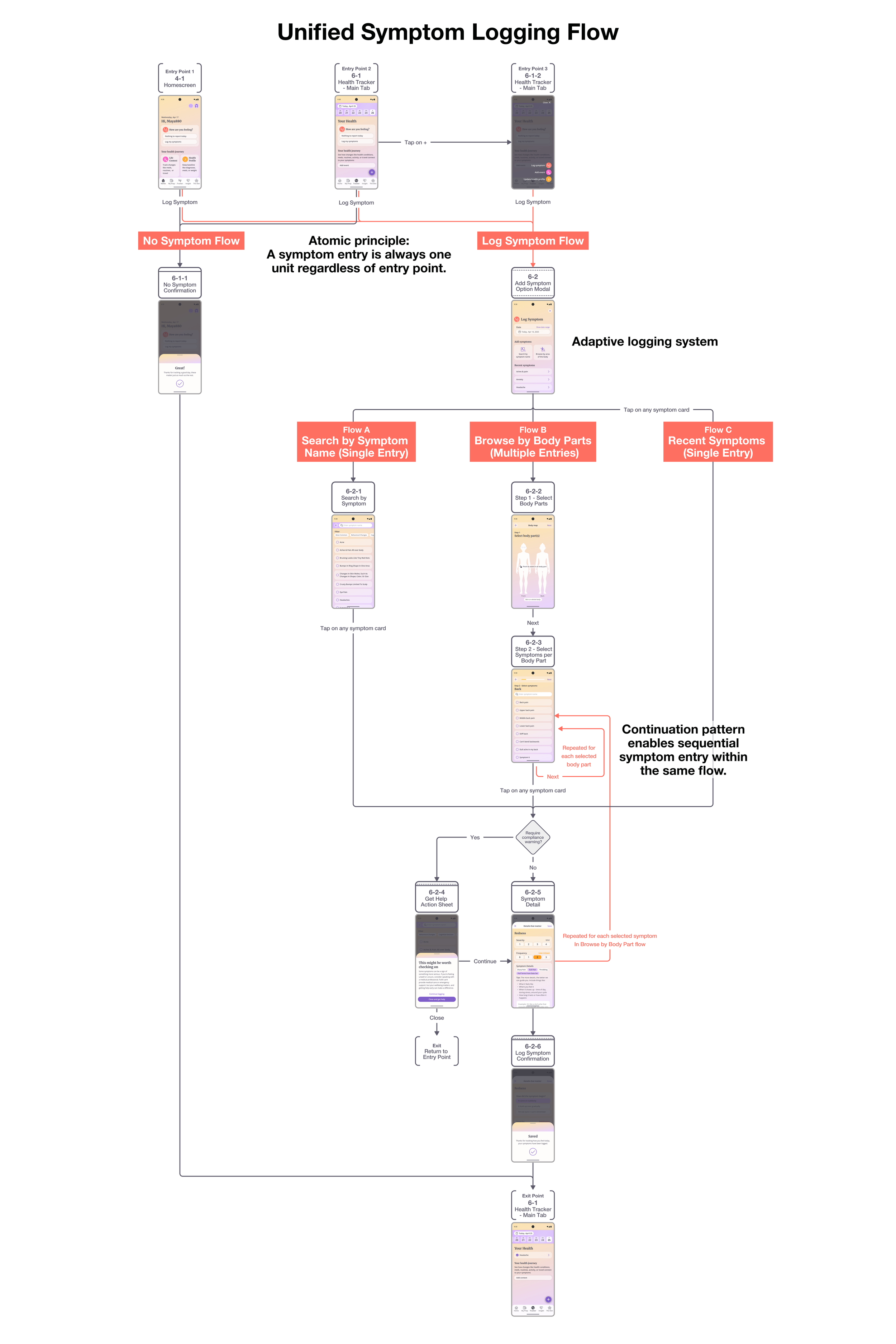
At the interaction level, I designed the symptom logging experience across multiple entry points — including search, body-based browsing, and recent activity — and unified them into a single atomic flow to ensure consistent behavior regardless of entry path.
At the system level, I worked with engineering and data science teams to define shared signal structures, validation requirements, and behavioral rules, creating a consistent framework for how health information is represented across the product.
Unifying Symptom Logging Behaviors
Challenge
Users held different mental models of how symptom data should be captured, depending on how they initiated logging.
Some treated symptom logging as direct recall (search by name), others as spatial discovery (body-based browsing), while returning users relied on recent or frequent symptoms for faster input.
While each approach supported valid behavior, they led to inconsistency in what “logging a symptom” meant across the system—particularly around expected detail and the structure of input at the point of capture.
This created fragmentation across discovery, repetition, and recall behaviors in the logging experience.
Solution
I designed the system around a single principle:
“A symptom entry is always treated as one atomic unit, regardless of how or where it is initiated.”
All entry points — search, body-based browsing, and recent activity — resolve into a single unified logging flow.
This ensures consistent behavior at the point of capture while supporting different user intent through contextual entry patterns.
The system adapts within this structure:
Exploratory entry is supported through search and body-based browsing for discovery
Recurring entry is optimized through recent symptom selection for fast re-entry
Historical entry is supported through date-based access within the same logging model
To improve efficiency without introducing batch complexity, I designed a continuation pattern within body-based browsing that allows sequential symptom entry without restarting the flow.
Defining a Unified Health Signal Model
Challenge
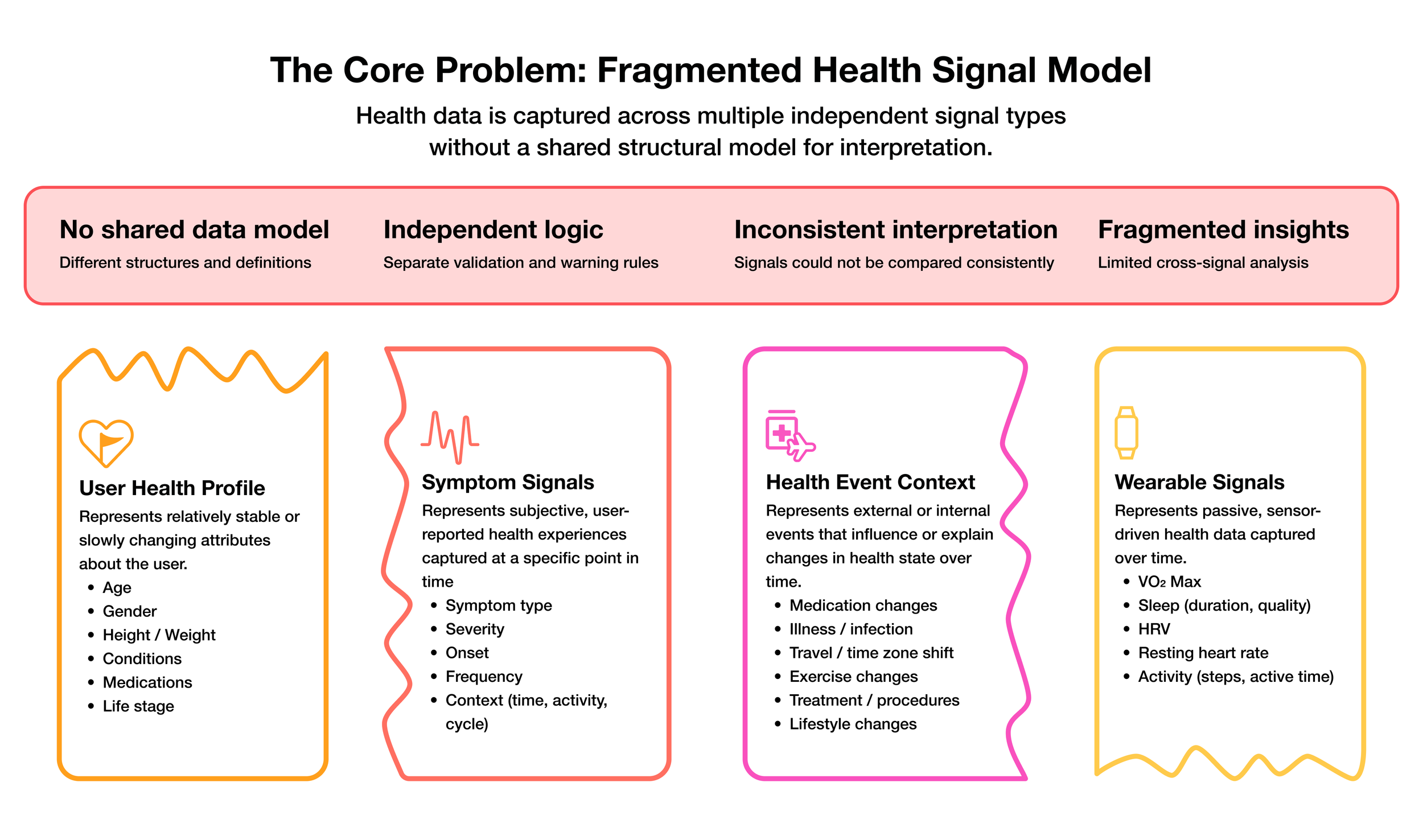
As FoXX Health expanded, health data became fragmented across multiple input types:
symptoms
wearable signals
contextual health events
user profile attributes
Each was defined independently, leading to inconsistent structure, unclear relationships between signals, and ambiguity in how data should be interpreted across the system.
Solution
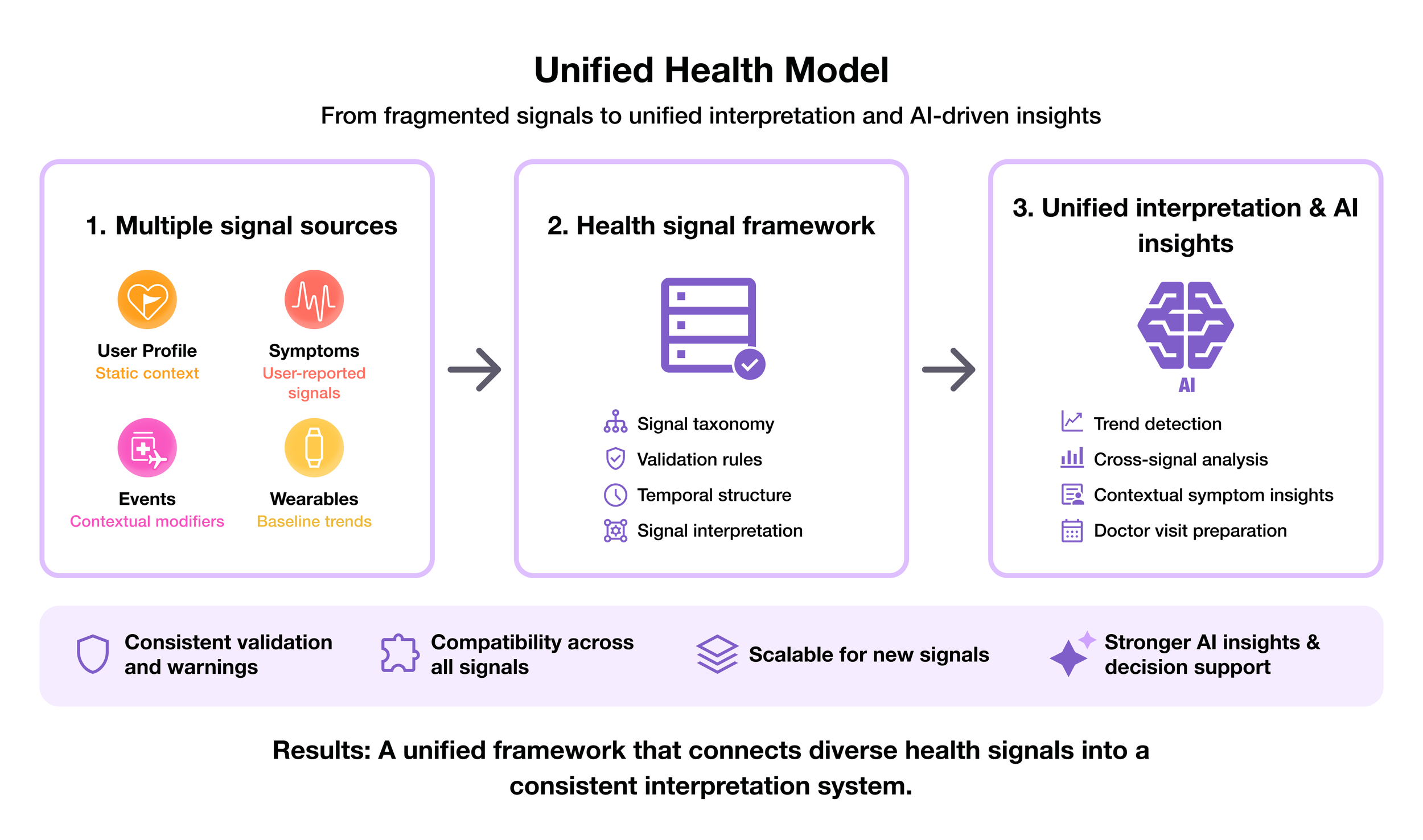
I defined a shared behavioral model for how health signals are structured and interpreted across FoXX Health.
Rather than treating each input type as a separate feature, I aligned all signals to a consistent framework so they could be captured and understood within the same system.
This ensures that different types of health data can be represented, related, and interpreted consistently across tracking, insights, and long-term understanding.
This included:
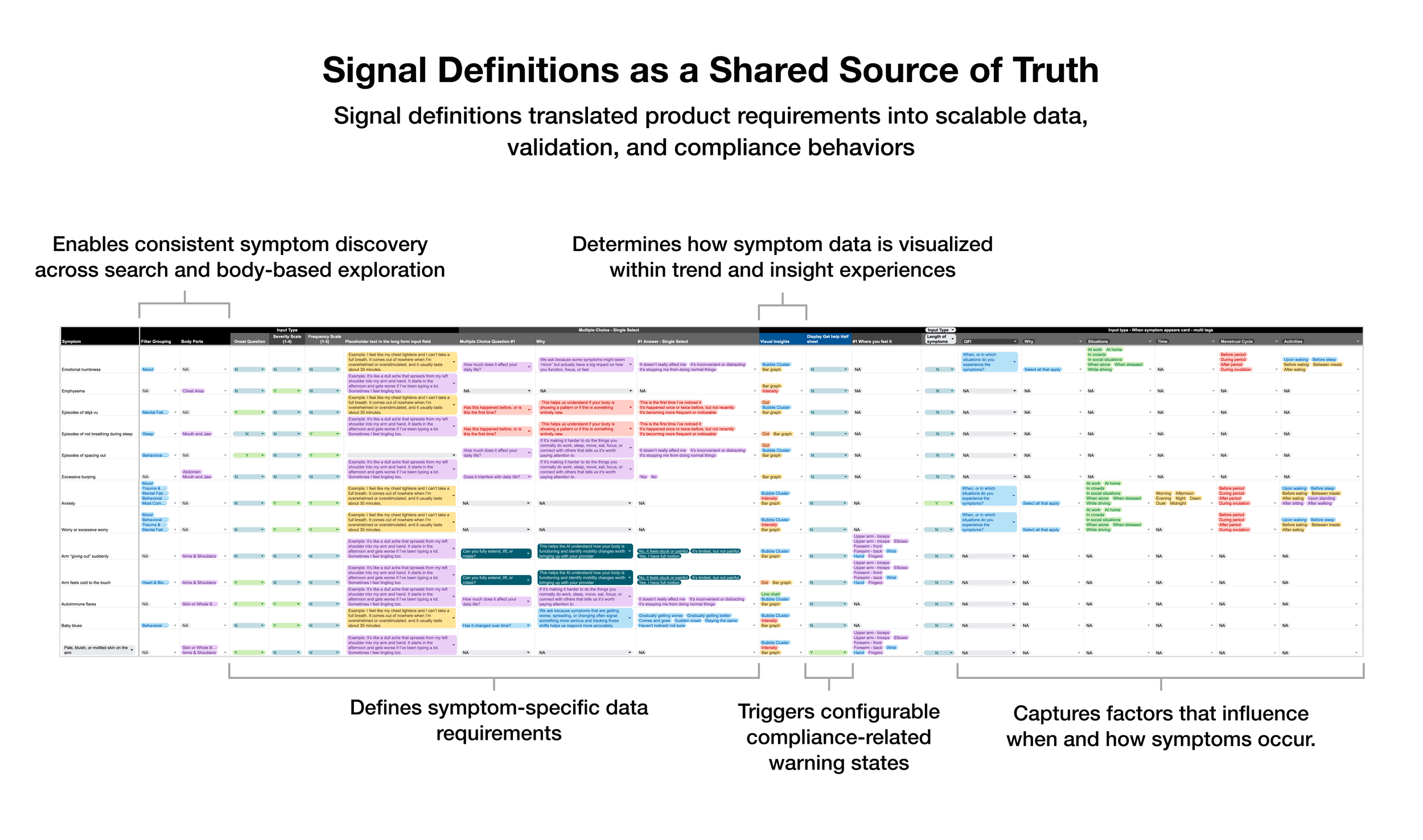
establishing consistent structures for symptom inputs
defining required and optional data based on signal type and input context
aligning behavioral differences between symptoms, contextual events, wearable trends, and profile attributes
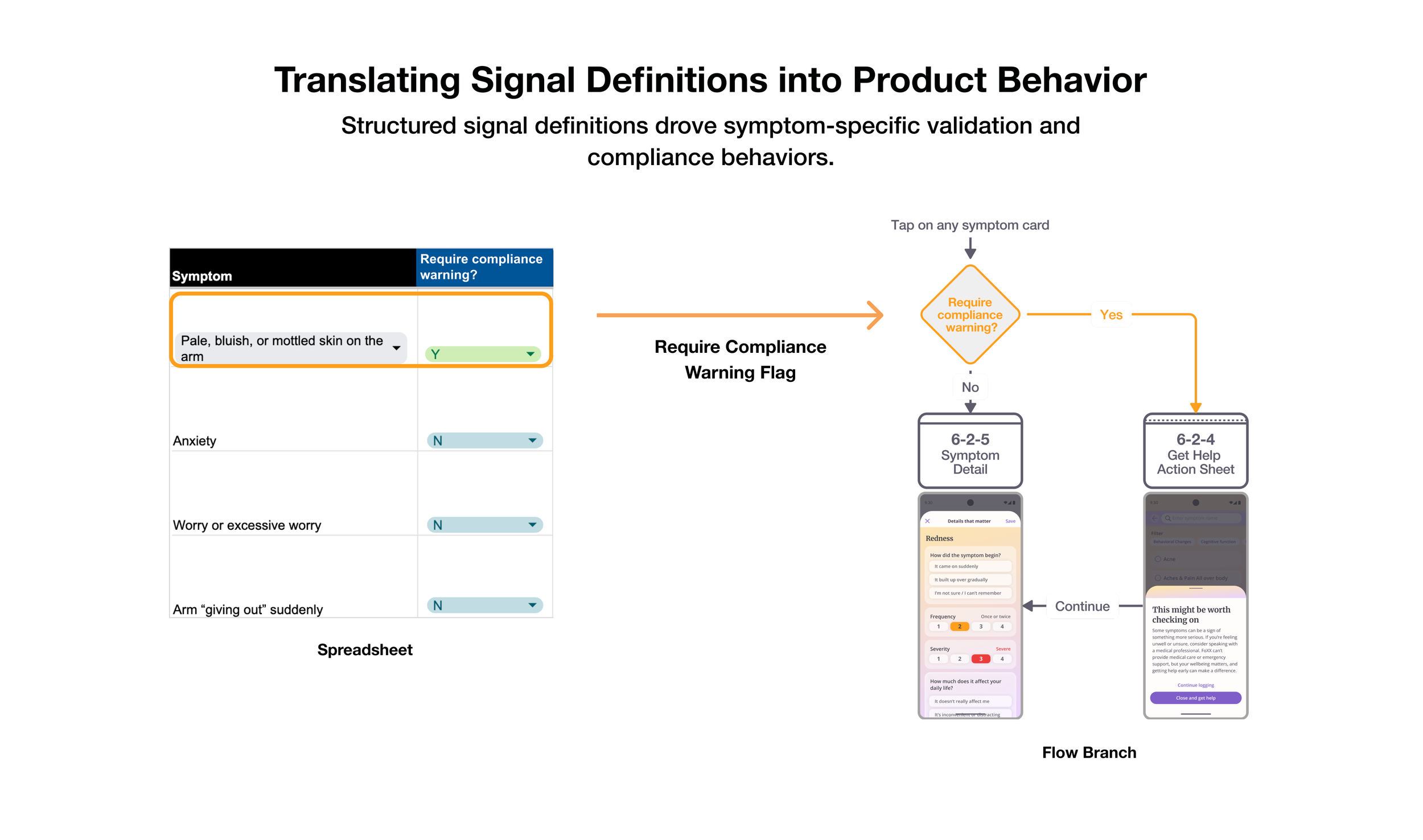
defining configurable compliance-related warning states for symptom-specific flows
To ensure implementation consistency across teams, I translated these definitions into spreadsheet-based specifications used as a shared reference across product, engineering, and data science.
Outcome
This work established a shared framework for how health signals are captured, structured, and connected across FoXX Health.
By aligning interaction behaviors, signal definitions, and validation requirements, the system can support new health inputs without introducing separate models for each feature.
The result is a more scalable platform with greater consistency across tracking and insight experiences.