
Designing an AI-Assisted Design-to-Code Workflow
Creating a structured workflow that connects design systems, AI-assisted processes, and engineering implementation.
—
Overview
Building product quickly while evolving the design system created an ongoing challenge: keeping design decisions and implementation aligned. Components, documentation, and code evolved simultaneously, increasing the risk of implementation drift and additional QA effort.
This project explores how AI-assisted workflows, structured governance, and standardized execution can improve alignment between design systems and engineering implementation.
Contribution
I designed an AI-assisted design-to-code workflow connecting Figma, structured design system documentation, code repositories, and implementation standards. The work established a repeatable AI workflow, governance for design system evolution, and reusable prompt templates that enabled consistent AI-assisted implementation across design and engineering.
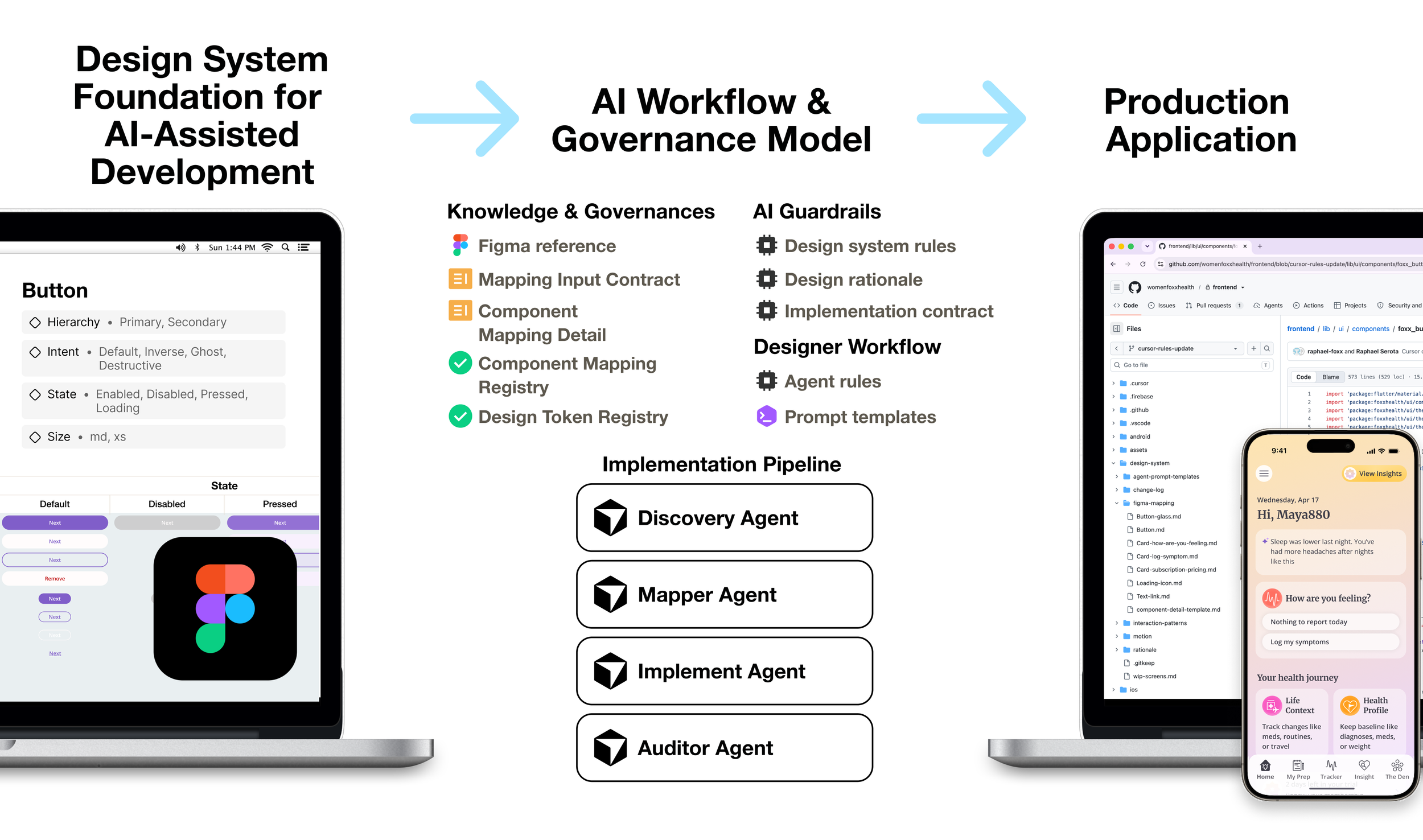
Evolving the Design System for AI-Assisted Development
Challenge
As the product evolved, individual design components accumulated multiple visual styles, behaviors, and implementation patterns within the same structure. The result was increasing translation between Figma and Flutter, making it harder for designers, engineers, and AI-assisted workflows to consistently interpret component intent.
The design system needed a stronger foundation that defined component relationships, implementation intent, and shared semantics for designers, engineers, and AI-assisted workflows.
Solution
I evolved the design system from a visual component library into a structured implementation architecture shared across Figma, Flutter, and AI-assisted development.
To improve alignment, I restructured the component architecture, introduced semantic component model and established clearer component boundaries so designers, engineers, and AI-assisted workflows referenced the same implementation model.
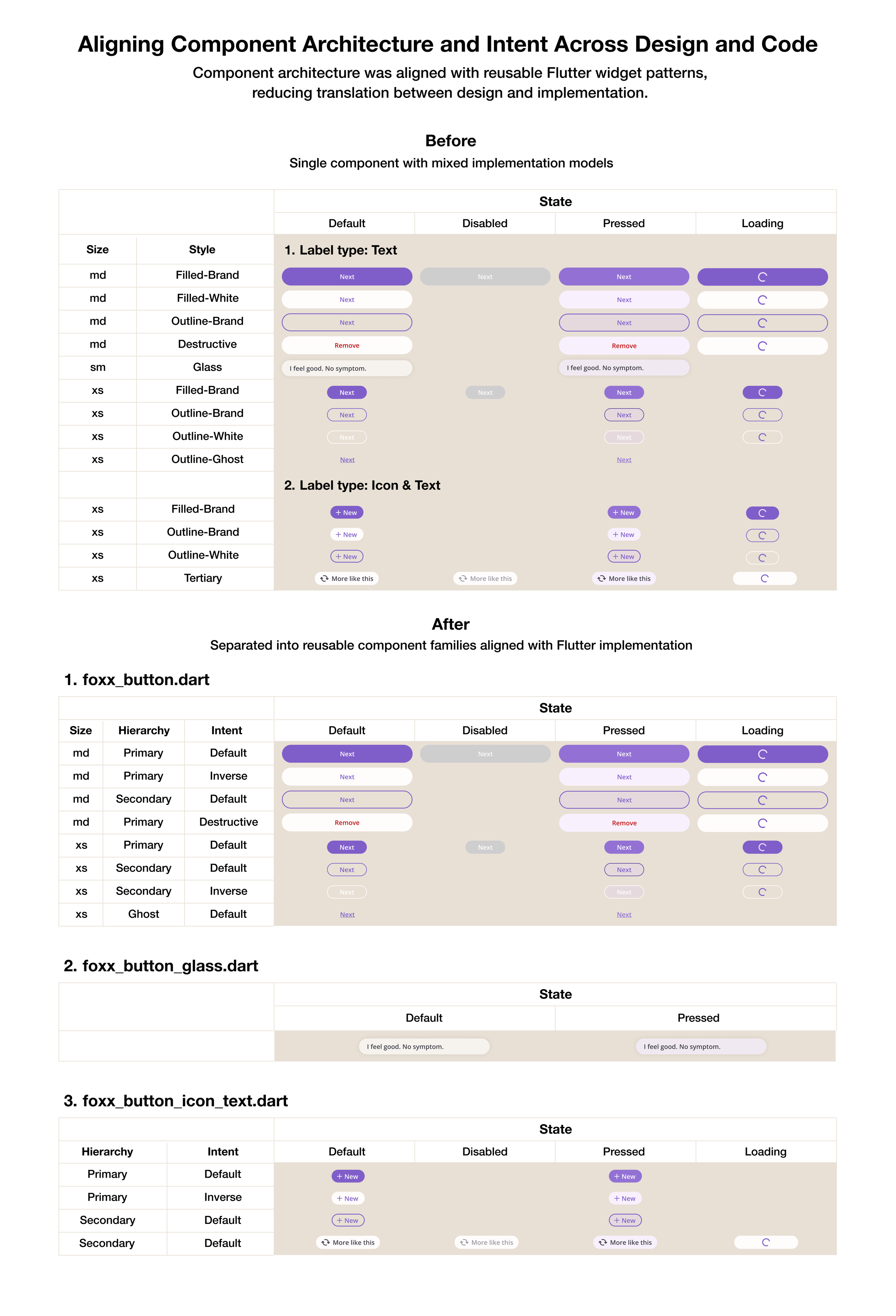
The restructuring reduced translation between design and implementation by giving designers, engineers, and AI agents a shared implementation model. It also established the architectural foundation for the AI-assisted workflows introduced in the following sections.
Designing AI-Assisted Workflow Architecture
Challenge #1
As AI-assisted development became part of the product workflow, the challenge wasn’t simply generating code faster—it was ensuring AI consistently respected design intent, existing components, and product-specific implementation decisions.
Early experimentation showed that AI could generate functional code, but without sufficient context it often missed existing patterns, design system constraints, and implementation standards.
The solution required more than better prompts. It required a repeatable workflow that clearly defined how design knowledge moved from exploration to implementation while preserving human decision-making where it mattered.
Solution
I designed an AI-assisted workflow architecture that separates exploration, discovery, implementation planning, code generation, and validation into distinct responsibilities.
Rather than relying on a single AI generation step, the workflow breaks design-to-code into specialized stages with defined responsibilities, verified artifacts, and structured handoffs. This creates a repeatable design-to-code workflow while maintaining design intent across Figma, Flutter, and AI-assisted implementation.
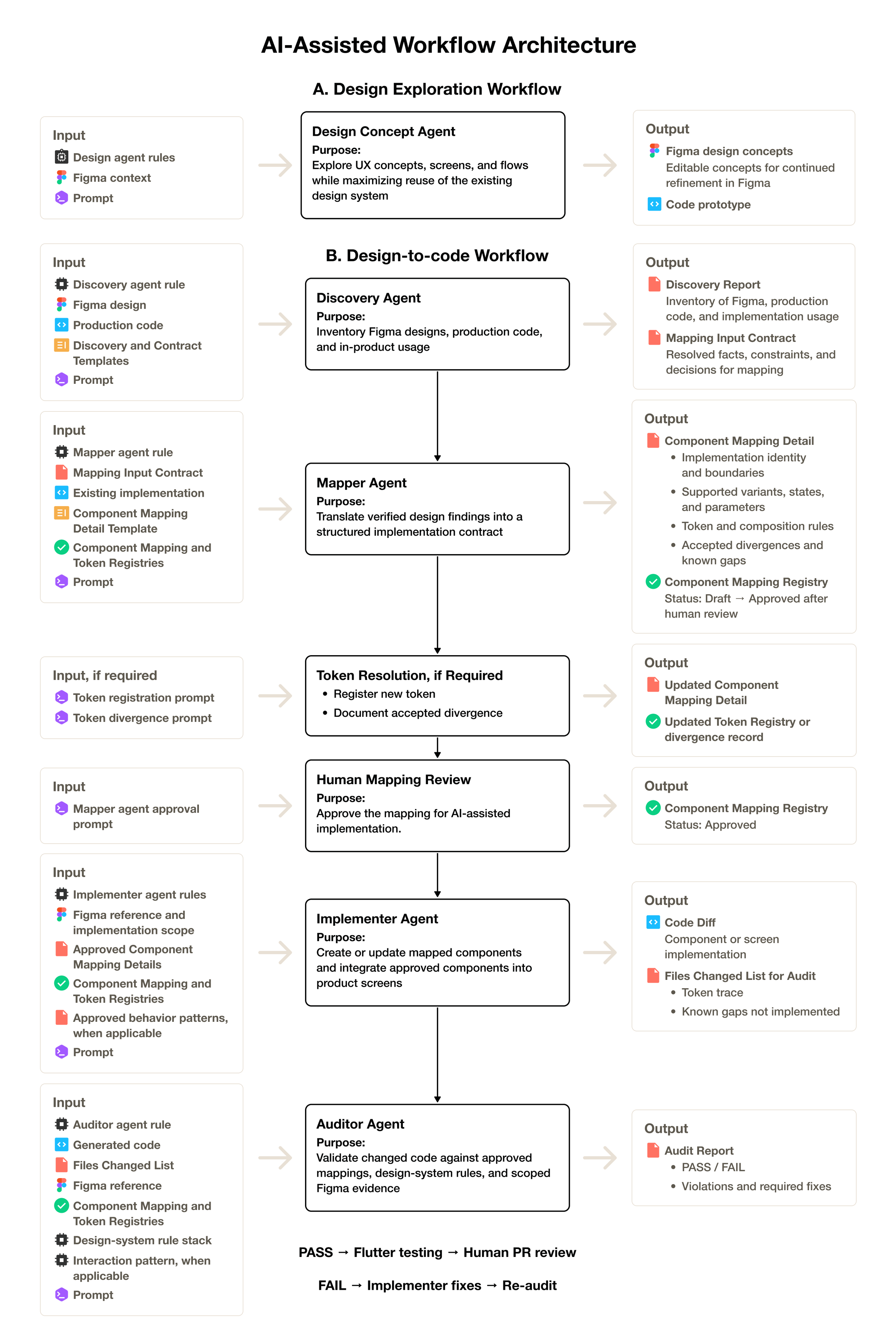
Supporting the workflow required establishing shared naming conventions between Figma components and Flutter widgets while transforming design system documentation into structured implementation artifacts. These artifacts became a shared implementation contract that aligned designers, engineers, and AI-assisted workflows around the same source of truth.
While this architecture standardized how AI-assisted development operated, executing the workflow still required designers to manually assemble the correct prompts and inputs for each task.
Challenge #2
While the workflow standardized AI-assisted development, executing it still depended on remembering the correct prompts, required inputs, and execution sequence. For designers unfamiliar with the underlying architecture, this created unnecessary cognitive overhead and reduced the repeatability the workflow was designed to achieve.
Solution
I created reusable prompt templates that package common design system tasks into guided workflows.
Instead of remembering complex prompts, designers simply select a use case, complete a small set of required inputs, and generate a standardized prompt for the appropriate AI agent.
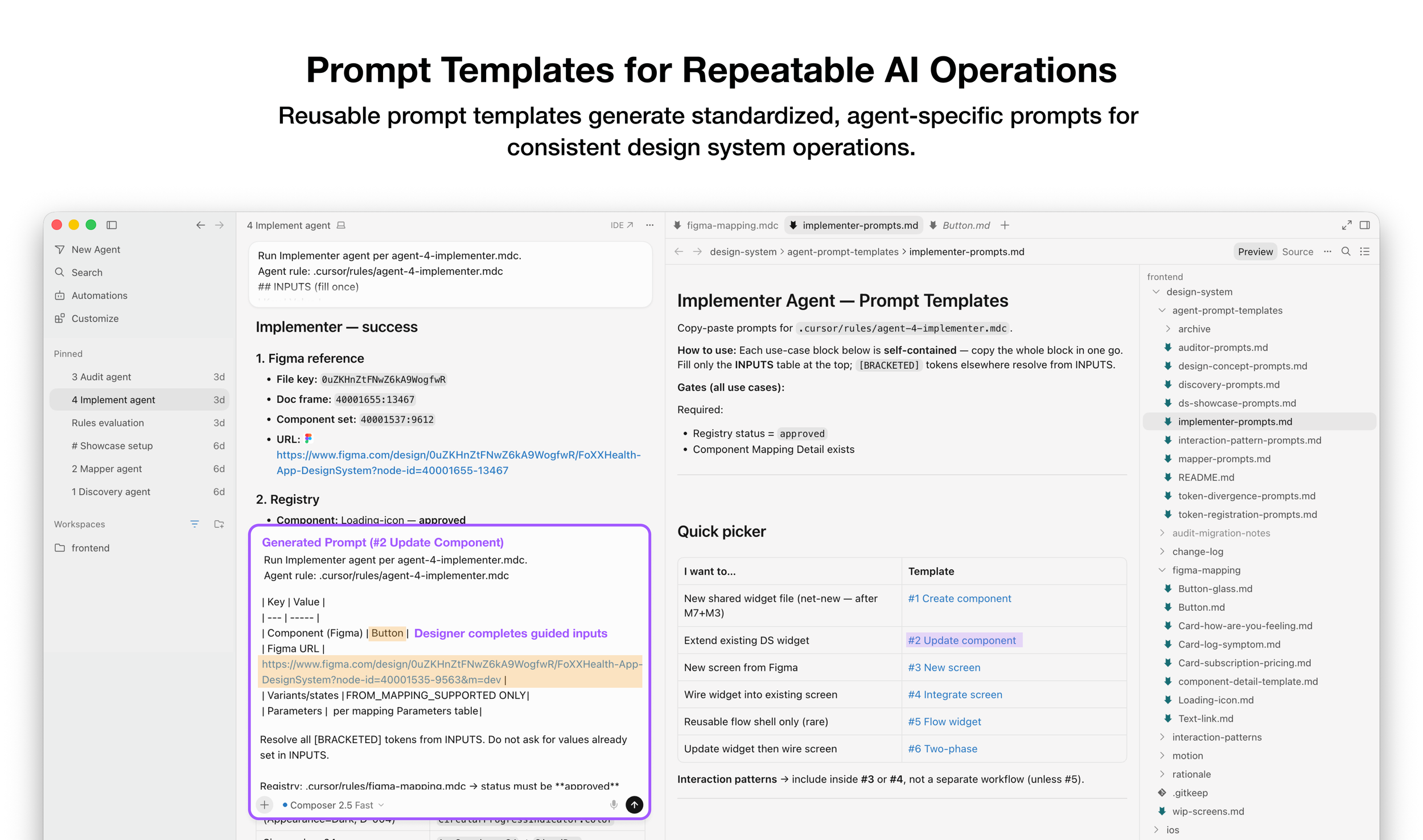
The templates transformed a complex multi-agent workflow into a guided experience that designers could use consistently without needing to memorize the underlying AI workflow.
Applying AI-Assisted Workflows to Product Development
Challenge
Design systems rarely exist in a perfect state. As the product evolved, new features needed to be delivered while existing components, tokens, and implementation patterns continued to require refinement.
A complete system cleanup before development was not practical. Existing components were already integrated into production experiences, requiring a balance between improving consistency and avoiding unnecessary disruption.
The challenge was introducing AI-assisted workflows into an active product while maintaining consistency and allowing the design system to evolve over time.
Solution
I applied the AI-assisted workflow across both new development and ongoing design system improvements, allowing implementation and system evolution to progress together.
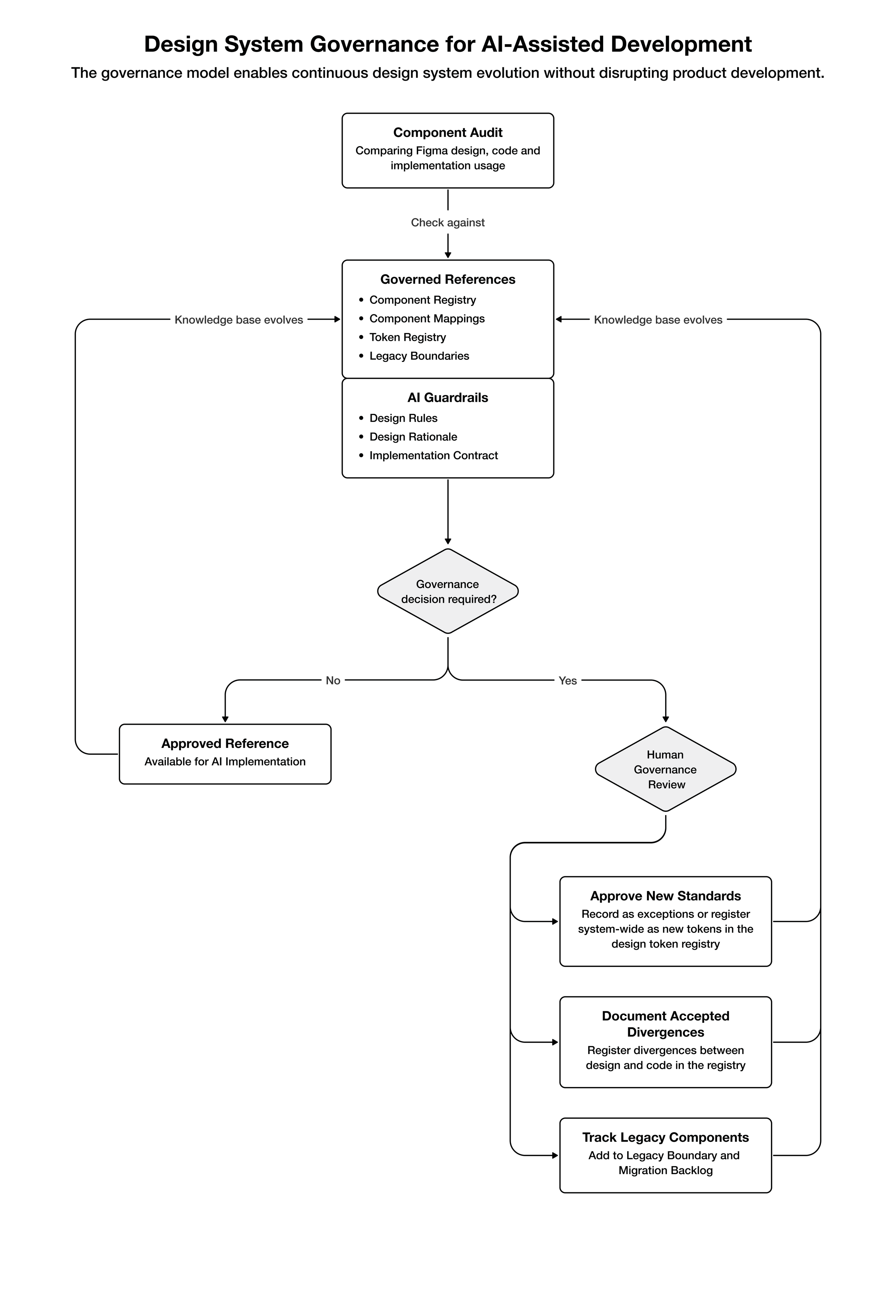
Rather than treating consistency as a one-time cleanup effort, this approach created a continuous refinement loop — allowing the design system to evolve alongside product development while maintaining implementation quality and delivery velocity.
Outcome
This work established a structured approach for integrating AI into product development without separating design systems from engineering implementation.
By strengthening the design system foundation, defining AI workflow architecture, and applying governed implementation practices within an evolving product, the workflow improved consistency while supporting continuous product delivery.